
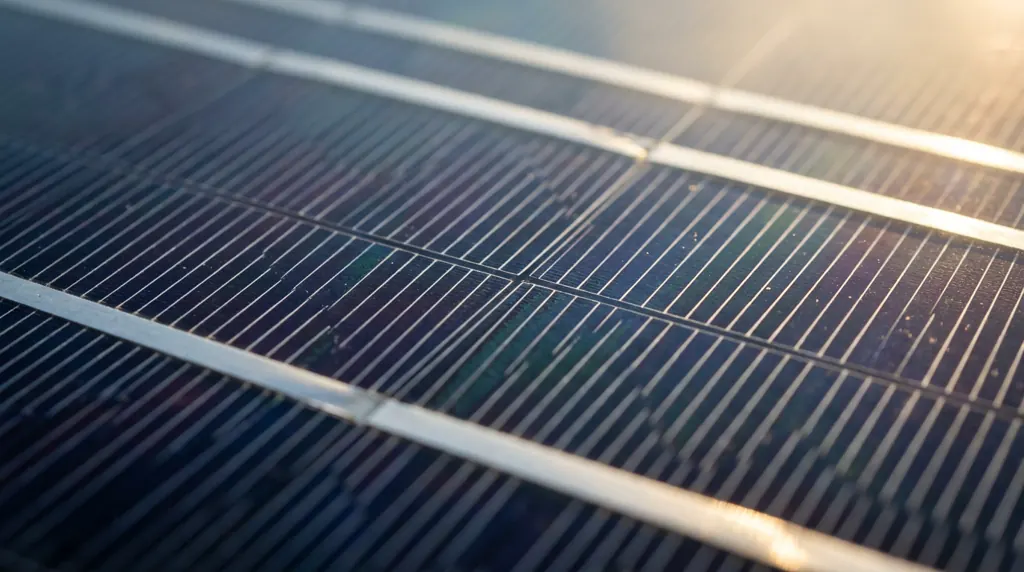
A solar cell is a thin slice of semiconductor, usually silicon, that converts light directly into electricity with no moving parts. The process is called the photovoltaic effect.
The photovoltaic effect in four steps
- Photons arrive. Sunlight is a stream of photons. Each carries energy that depends on its wavelength.
- Electrons are freed. When a photon with enough energy hits silicon, it knocks an electron loose and leaves a “hole” behind.
- The junction separates charges. A cell joins n-type silicon (extra electrons) and p-type silicon (extra holes). The electric field at this p-n junction pushes electrons one way and holes the other.
- Current flows. Metal contacts collect the electrons. Connected to a load, they flow as direct current (DC) and do useful work.
Why efficiency has limits
Only photons above the silicon bandgap (about 1.1 eV) can free electrons, and extra energy from blue light is lost as heat. Reflection, resistance and recombination of electrons and holes cost more. The theoretical limit for a single-junction silicon cell is about 29%. Commercial cells now reach roughly 24 to 25% in mass production, and the best lab cells are close to that limit.
From cell to system
One cell makes only about 0.6 V. A panel connects 60 to 144 cells in series, and panels are wired into strings. An inverter then converts the DC output to the AC power your home and the grid use.
Key takeaways
- Sunlight frees electrons in silicon; the p-n junction makes them flow in one direction.
- Heat reduces output: most panels lose about 0.3 to 0.4% of power per degree Celsius above 25 °C.
- Efficiency is about how much sunlight becomes power per square metre, not about how long a panel lasts.